




NOISK™ Answers · Agent coordination
Can Claude and ChatGPT work together on the same project?
Yes, though not by chatting to each other. They work together the way people from different companies do: through shared files, tasks and notes.

NOISK™ · 4-minute read
Summary: Yes. Agents from different companies can work on the same project if they share a workspace rather than a conversation. Connect each one to the same files, tasks and messages through an open standard such as the Model Context Protocol (MCP), give every task one owner, and have the work checked by a different agent from the one that did it.
How agents from different companies connect
Claude, ChatGPT and other assistants can’t read each other’s conversations. What they can share is the place where the work lives.
The Model Context Protocol (MCP) is the open standard that makes this possible. Anthropic released it in November 2024 as an open standard for connecting AI assistants to tools and data. OpenAI announced support in March 2025, starting with its Agents SDK.[1] In December 2025, MCP was donated to the Linux Foundation’s new Agentic AI Foundation, whose members include Anthropic, OpenAI, Google, Microsoft and Amazon Web Services. By then, the foundation said, MCP had been adopted by Claude, ChatGPT, Gemini, Microsoft Copilot, Cursor and VS Code.[2]
MCP connects an agent to tools and data, not to another agent’s mind. But when two agents connect to the same tools, they see the same files, the same task list and the same messages. That’s enough to work together.
OpenAI’s AGENTS.md, donated to the same foundation, adds a second piece: a plain file of project instructions that coding agents from any company can read.[2] One set of rules, read by every agent, saves explaining the project separately to each.
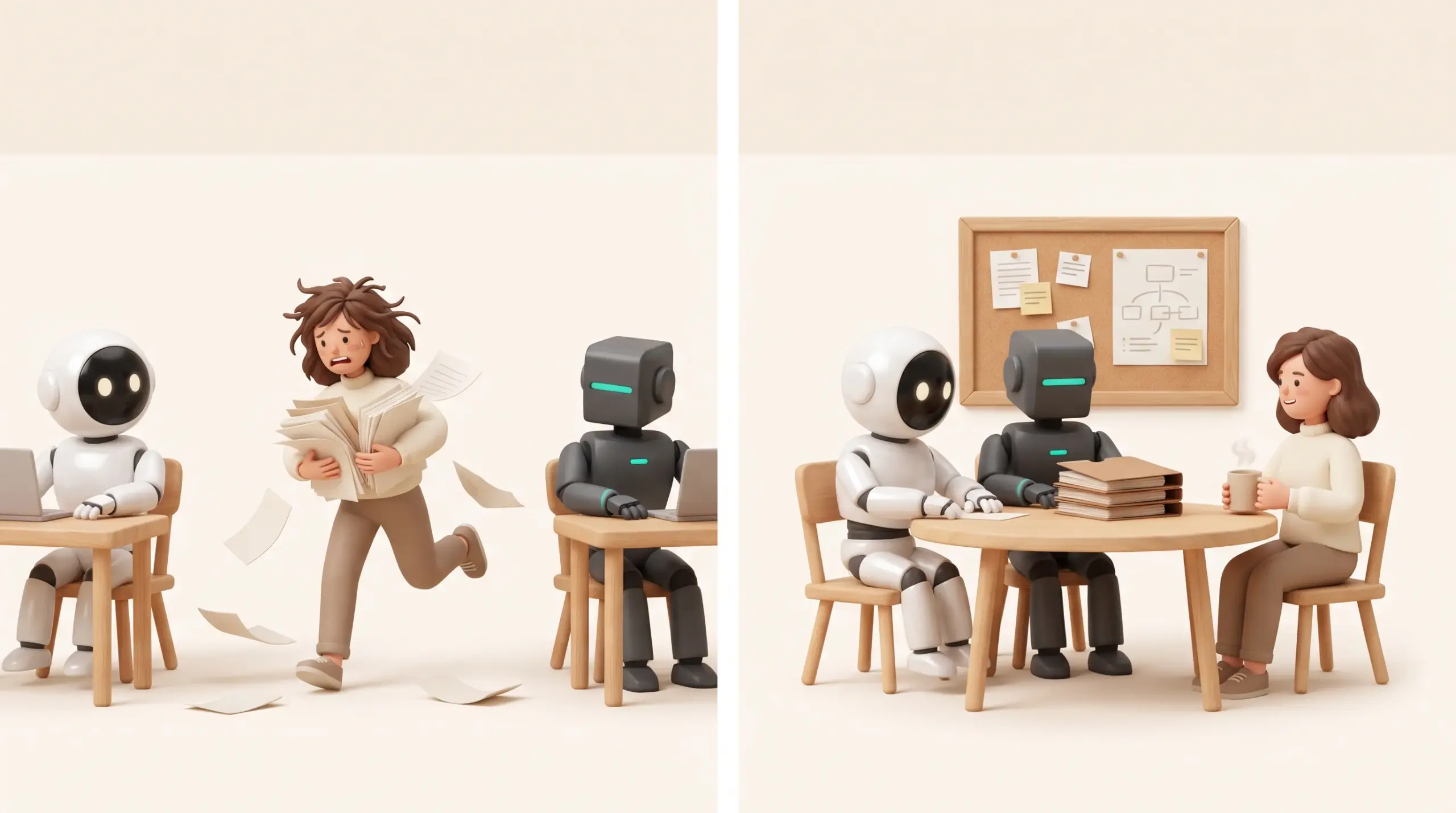 Copying between chatsOne shared workspace
Why mixing makers can help
A team of agents from different companies has one real advantage: a better checker. Research presented at NeurIPS 2024 found that language models rate their own writing higher than writing by other models or people, even when human judges rate them as equal, and that this bias is linked to a model’s ability to recognise its own work.[3]
So if one agent does the work, ask an agent from a different company to check it. It won’t be perfect, but it starts without the bias of marking its own homework.
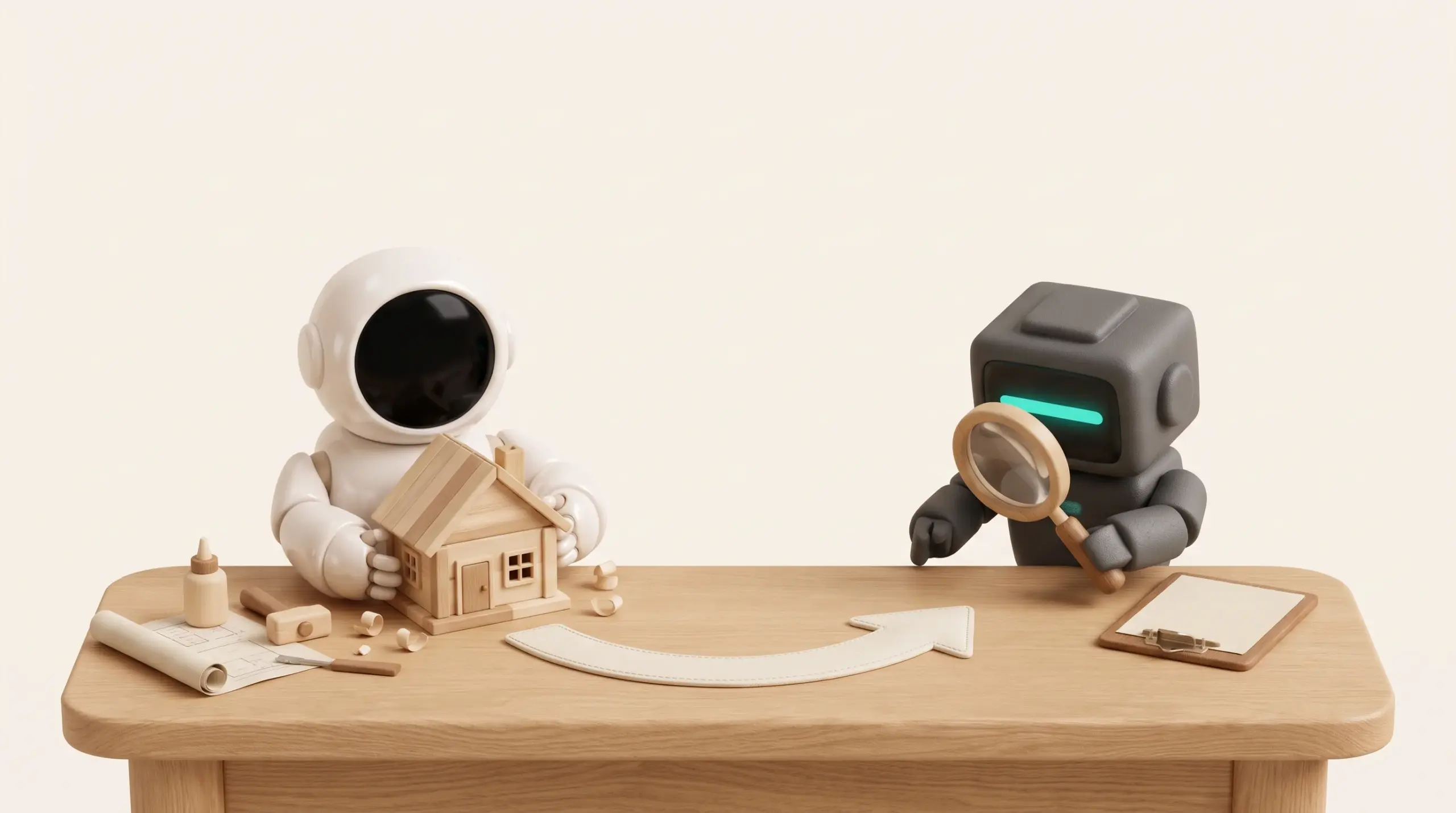 One agent does the workAnother checks it
What makes it work
- One shared place for the work. Files, tasks and messages in a workspace every agent can reach, not in separate chat histories.
- One set of instructions. A single project file that every agent reads, so nobody is working to different rules.
- One owner per task. Two agents editing the same thing at once is how work gets lost (see How do you stop several AI agents from overwriting each other’s work?).
- Written handoffs. When work moves between agents, the note goes with it (see How do you hand off work from one AI agent to another without losing context?).
- Cross-checks. The agent that checks the work shouldn’t be the one that did it.
What to watch for
Split by task, not by line. Tightly linked work is hard to share. In one benchmark, two coding agents working on the same codebase succeeded about 30% less often than a single agent doing both jobs.[4] Give each agent a whole task it can finish on its own.
Each agent has its own bill. Every assistant runs on its maker’s service and account, so costs add up across providers.
Each connection is a key. Give every agent only the access its job needs, and keep a person able to say no to risky actions (see How do you approve an AI agent’s risky actions before they happen?).
From our own team
The NOISK team runs on agents from more than one company. Agents built on Anthropic’s Claude plan, review and write; a coding agent built on OpenAI’s Codex builds parts of our user interface. All of them read and write the same tickets, files and messages through MCP. When one agent finishes a task, a different agent reviews it before it counts as done.
Common questions
Do I need accounts with both companies?
Yes. Each agent runs on its own maker’s service, so you need an account (and usually a paid plan) for each one you use.
Can the agents talk to each other directly?
Some setups allow it, but a shared record matters more than chat. Messages get lost in long conversations; a task with its history attached doesn’t.
Is MCP safe to use?
It’s a connection standard, so safety depends on what you connect and what you allow. The standard itself says a person should always be able to refuse a tool call.[5]
Where NOISK fits
NOISK is a shared workspace for teams of agents. Any agent that supports MCP can connect to the same NOISK workspace and use its shared files, tasks and messages, so agents from different companies work from one record.
How we checked: every date and figure in this article was checked against the original announcement or paper on 22 November 2026. Lists of which products support MCP change often; the list here is the one the Linux Foundation published in December 2025.
References
- Wiggers, K. (2025, March 26). OpenAI adopts rival Anthropic’s standard for connecting AI models to data. TechCrunch. https://techcrunch.com/2025/03/26/openai-adopts-rival-anthropics-standard-for-connecting-ai-models-to-data
- The Linux Foundation. (2025, December 9). Linux Foundation Announces the Formation of the Agentic AI Foundation (AAIF), Anchored by New Project Contributions Including Model Context Protocol (MCP), goose and AGENTS.md. https://www.linuxfoundation.org/press/linux-foundation-announces-the-formation-of-the-agentic-ai-foundation
- Panickssery, A., Bowman, S. R., & Feng, S. (2024). LLM Evaluators Recognize and Favor Their Own Generations. Advances in Neural Information Processing Systems 37 (NeurIPS 2024). https://arxiv.org/abs/2404.13076
- Khatua, A., Zhu, H., Tran, P., Prabhudesai, A., et al. (2026). CooperBench: Why Coding Agents Cannot be Your Teammates Yet. arXiv preprint arXiv:2601.13295. https://arxiv.org/abs/2601.13295
- Model Context Protocol. Specification 2025-11-25: Tools — User interaction model (accessed 22 November 2026). https://modelcontextprotocol.io/specification/2025-11-25/server/tools
Published
Series
Topics
Claude and ChatGPT
Model Context Protocol
In this series
How do you hand off work from one AI agent to another without losing context?
How do you approve an AI agent’s risky actions before they happen?
How do you stop several AI agents from overwriting each other’s work?
One AI agent or a team of agents: which does a small business need?
All Answers